Why does putting remain the weakest part of most home golf simulator setups?
Full shots feel convincing on a good bay, then the ball reaches the green and the illusion thins. Understanding why helps you choose a setup, and a set of expectations, that keeps the short game honest.
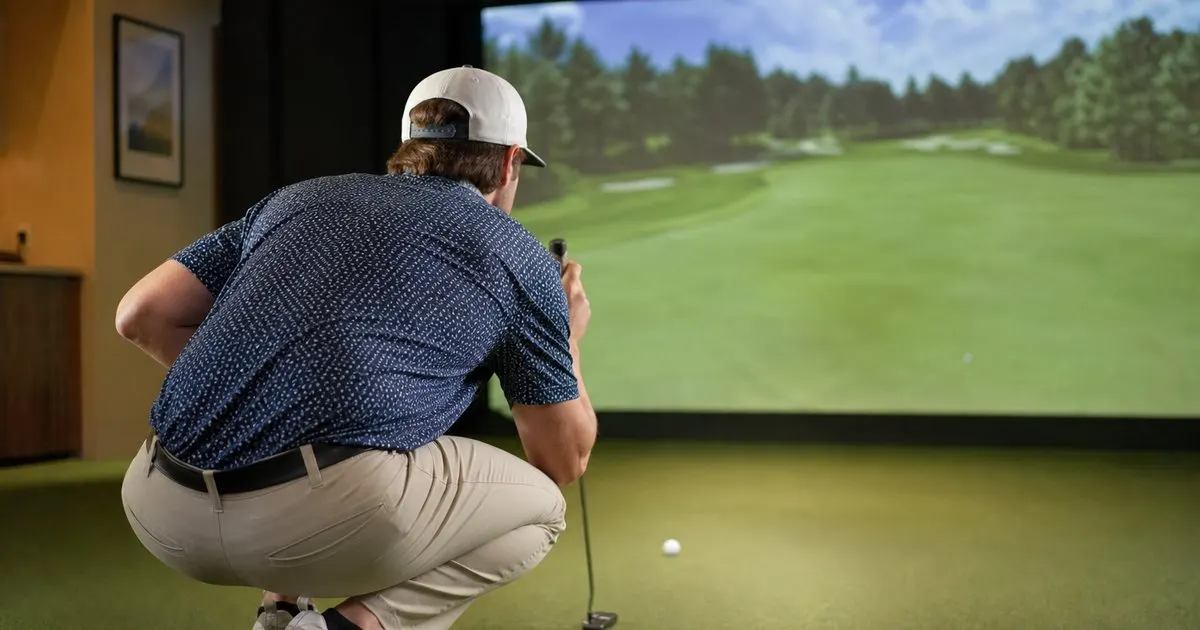
Flat mat, sloped green: the mismatch at the heart of it
The fundamental problem is physical. Your ball rolls across a flat mat while the software shows a green that tilts left to right and falls away toward the hole. The program can calculate how the virtual ball should break, but you cannot feel the slope through your feet, cannot see the grain and cannot read the subtle rise near the cup the way you would on grass. What you get is a putt that starts on the line you struck and then curves according to a model, which turns green reading into a guess about what the software will do rather than what the ground will do.
Speed compounds the issue. Every turf has its own rolling resistance, and the software has its own idea of green speed. If the two do not agree, a putt that feels like the right weight on the mat arrives at the virtual hole hot or short, and the golfer starts adjusting stroke to the software instead of to the surface. Some platforms let you tune the green speed setting to match your mat, which helps, but the calibration has to be redone whenever the turf wears or is replaced.
Keep reading: How much space does a premium home golf simulator bay actually require?, Which launch monitor technology gives the most accurate readings for home use?, What separates a five thousand dollar bay from a fifteen thousand one?. See how Golfbayr helps you the complete guide to premium home golf simulators.
How launch monitors see a putt
Launch monitors are built to measure a ball leaving the face at speed. Radar units in particular need the ball to move some distance at a reasonable pace to lock on, and a soft eight foot putt gives them very little to work with; readings become inconsistent or the unit ignores the stroke entirely. Camera based units generally do better because they photograph the ball at impact, but even then the accuracy of a slow roll is nowhere near what the same sensor delivers with a seven iron. Related: Which launch monitor technology gives the most accurate readings for home use?
Then there is the room. In a typical bay the screen sits ten to fifteen feet from the mat, so a putt of any real length reaches the screen before it would have reached the hole. The software has to project the rest of the roll from what it measured in the first few feet, and any error in that measurement is magnified over the remaining distance. This is why so many golfers switch to automatic putting inside a chosen distance or accept generous gimmes, and why that is a reasonable choice rather than a failure of nerve.
Setups that make putting worth the effort
If putting matters to you, plan for it as its own space. A longer room with a dedicated putting area beside or behind the hitting mat lets you roll putts on a consistent surface without the ball meeting the screen, and pairing that area with a purpose built putting sensor, where the software supports one, produces far more credible results than asking a full swing launch monitor to moonlight. Choose putting turf with a speed close to the greens you play and set the software to match. Related: How much space does a premium home golf simulator bay actually require?
Some households take a hybrid approach: full swing and approach shots on the simulator, then real putting on a contoured indoor green in the same room or nearby. It costs floor space, but it gives the one thing no software can provide, which is ground that actually slopes under the ball. If the room cannot accommodate that, the next best investment is a quality flat putting mat and the discipline to practice pace and start line, the two skills that transfer directly to the course. Related: Should you choose a ceiling mounted or floor standing simulator setup?
A realistic expectation for the short game
Treat the simulator as a superb tool for full swing work, wedge distance control and the decision making of playing a round, and treat putting as the part of the experience that is closest to a game. Setting automatic putting for anything inside a modest distance keeps rounds moving and prevents a rough putting model from distorting your score, which matters if you use simulated rounds to track progress. Related: How do professional installers soundproof a home golf bay for daily play?
Chipping and pitching sit in between: from ten or more feet back the sensors read a chip well, though be aware that hitting the screen from very close with a high lofted wedge can leave marks on the fabric and shorten its life, so keep the mat at the distance the enclosure maker recommends. Putting mats and sensors linked from this page may earn the site a commission. The honest summary is that a bay can make you a far better ball striker, and it will make you a better putter only if you build a real putting surface into the plan.
- A flat mat cannot reproduce the slope that the virtual green shows, so break becomes a guess about the software.
- Full swing launch monitors read slow, short putts poorly, and the ball reaches the screen before the hole.
- A dedicated putting area with a purpose built sensor or a real contoured green transfers to the course.
- Using automatic putting inside a chosen distance is a sensible way to keep simulated scores meaningful.

Julien Jimenez
Julien Jimenez is an independent software builder based in Paris. He designs, ships, and operates focused SaaS products for small businesses and independent professionals. Read the full author page.
Your Game, Ready Every Morning
The complete guide to premium home golf simulators. Golfbayr is built to help you put this into practice.
Build your bayMore from the Golfbayr blog

How much space does a premium home golf simulator bay actually require?
Which launch monitor technology gives the most accurate readings for home use?
What separates a five thousand dollar bay from a fifteen thousand one?
Get the complete home golf simulators guide
Our full buying guide, the price guide, and new research as we publish it. One email, no spam, unsubscribe any time.