Why does your hitting mat deserve as much scrutiny as the launch monitor?
The mat is the one component you touch on every swing. It shapes the feedback you receive, the strain on your joints and even the numbers your sensors report, yet it often appears as an afterthought on the quote.
The mat is a feedback system, whether you chose it or not
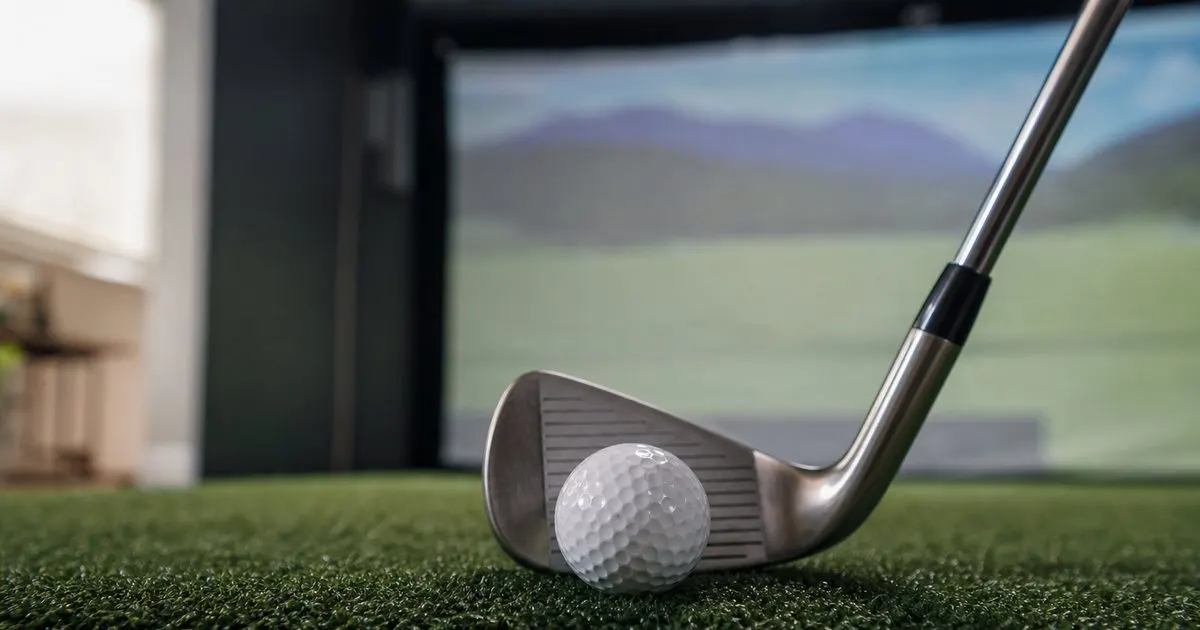
Every strike on a hitting mat tells you something, and a poor mat tells you something false. On a thin, hard mat a shot struck two inches behind the ball bounces the club into the back of the ball and produces a flight that looks fine on the screen. On a fairway that same swing takes a divot and travels half the distance. Golfers who practice all winter on a forgiving surface then wonder why their contact falls apart in April, and the mat is usually the reason. The better mats use a dense turf over a base that compresses under a heavy strike, so a fat shot feels fat and shows up in the launch monitor data as lower ball speed and a lower smash factor. Related: Why does impact screen quality matter more than most buyers expect?
Turf construction also changes how the ball sits. A tall, soft pile lets the ball nestle slightly, closer to a real fairway lie, while a short, stiff nylon pile holds the ball up on top like a perfect preferred lie every time. Neither is wrong, but you should know which one you are practicing from. Tee height is affected in the same way: mats that accept a rubber tee through the turf behave differently from mats with a tee holder, and a golfer who tees a driver on one surface and then plays a course with wooden tees can find their launch window shifts more than expected.
Keep reading: How much space does a premium home golf simulator bay actually require?, Which launch monitor technology gives the most accurate readings for home use?, What separates a five thousand dollar bay from a fifteen thousand one?. See how Golfbayr helps you the complete guide to premium home golf simulators.
Joints, elbows and the long game of daily practice
A club decelerating into a hard surface sends a shock up the shaft and into the wrists, elbows and shoulders. Golfers who hit hundreds of balls a week indoors on a mat laid directly over concrete often develop the aching forearm and elbow symptoms that outdoor players rarely see, because turf on soil absorbs energy that a mat on a slab returns straight to the body. The fix is layered: a mat with a meaningful shock absorbing base, an additional underlayment of dense foam or rubber beneath it, and a stance area built up to the same height so the golfer stands level with the ball rather than perched on a raised pad.
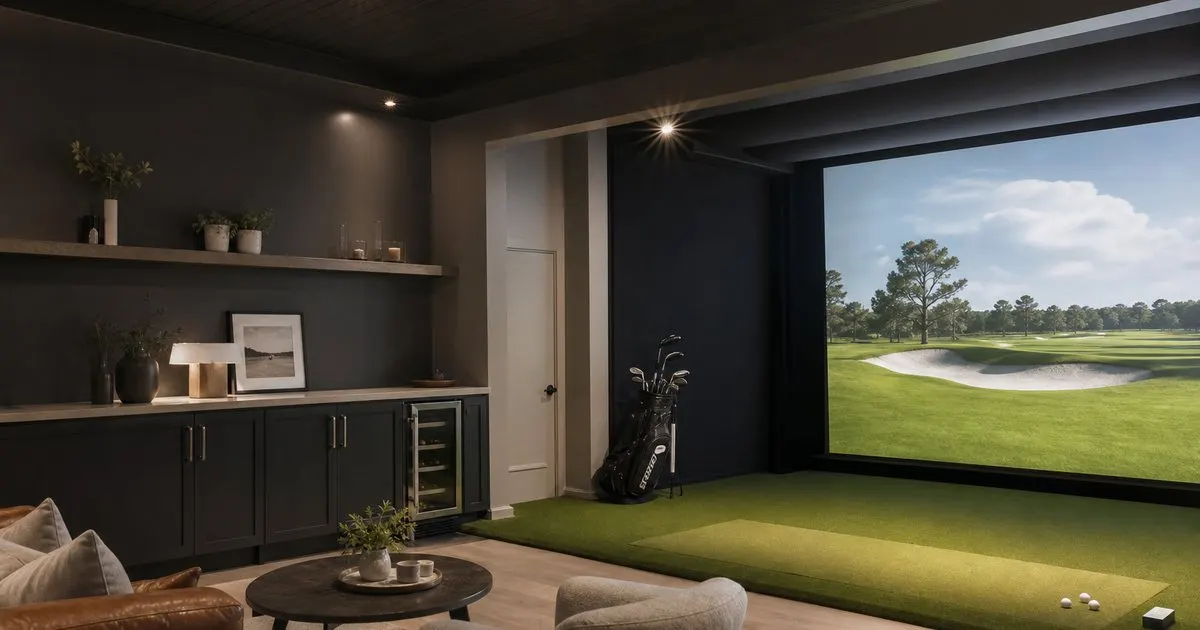
Premium bays go a step further and build a raised platform across the entire hitting area, then recess the mat so the hitting surface sits flush with the surrounding stance turf. This does more than protect joints. It removes the trip edge that a loose mat creates, keeps the ball from rolling off a raised rectangle, and lets the installer level the platform even when the slab underneath slopes, which is the norm in garages and common in older basements. It is the kind of detail that separates a bay that feels like a room built for golf from a room with golf equipment in it. Related: How much space does a premium home golf simulator bay actually require?
How the mat quietly affects your launch monitor
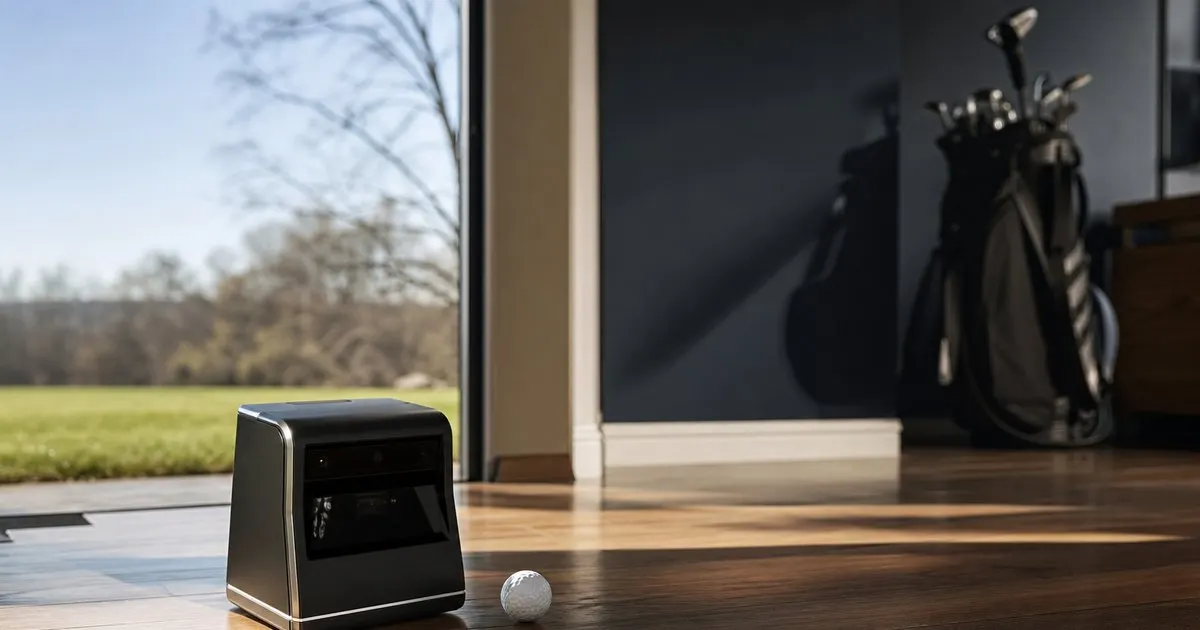
Camera based launch monitors photograph the ball and club from a fixed position, and they are calibrated to a specific ball height above the floor. Swap a thin mat for a thick one without recalibrating and the unit is now measuring a ball that sits an inch higher than it expects, which can skew launch and spin readings in subtle ways that are hard to notice until your carry numbers stop matching the course. Overhead units are especially sensitive to this and typically require the hitting zone to sit within a marked area, so the mat must be positioned precisely and stay there.
Radar units placed behind the ball are less fussy about mat thickness but very particular about ball position, usually needing the ball a fixed distance from the sensor. A mat with a clearly identifiable hitting strip helps the golfer place every ball in the same spot. Colors matter too: very bright or reflective fibers can confuse camera systems in certain lighting, and a mat with printed alignment lines that do not match the unit's expectations can be more distraction than aid. Confirm your launch monitor's requirements before buying a mat, not after. Related: Which launch monitor technology gives the most accurate readings for home use?
Choosing wisely: size, modularity and replaceable inserts
Full stance mats that combine a hitting area and standing area in one piece look tidy but wear unevenly, since the center hitting strip takes every shot while the edges stay pristine. Modular systems with a replaceable hitting insert let you swap only the worn section, and some offer interchangeable fairway, rough and tee inserts so you can practice from different lies without changing the whole surface. For households with golfers on both sides of the ball, a mat with hitting zones at each end or a symmetrical layout avoids constant rearranging.
Budget for the mat in proportion to the rest of the bay. On a build in the five to fifteen thousand dollar range, the mat is a small share of the total, and upgrading from a basic pad to a shock absorbing, modular system is one of the least expensive ways to improve how the bay feels every single day. Mat links on this site may be affiliate links that pay a commission. Even so, put your hands on a sample if you can, hit a few fat shots on it, and buy the one that tells you the truth. Related: What separates a five thousand dollar bay from a fifteen thousand one?
- A forgiving mat hides fat shots indoors and sets you up for chunks on the course.
- Layered shock absorption and a flush stance platform protect elbows and wrists over months of practice.
- Mat thickness and color can shift launch monitor calibration, so match the mat to the sensor.
- Modular mats with replaceable hitting inserts wear gracefully and cost little relative to the bay.

Julien Jimenez
Julien Jimenez is an independent software builder based in Paris. He designs, ships, and operates focused SaaS products for small businesses and independent professionals. Read the full author page.
Your Game, Ready Every Morning
The complete guide to premium home golf simulators. Golfbayr is built to help you put this into practice.
Build your bayMore from the Golfbayr blog

How much space does a premium home golf simulator bay actually require?
Which launch monitor technology gives the most accurate readings for home use?
What separates a five thousand dollar bay from a fifteen thousand one?
Get the complete home golf simulators guide
Our full buying guide, the price guide, and new research as we publish it. One email, no spam, unsubscribe any time.